
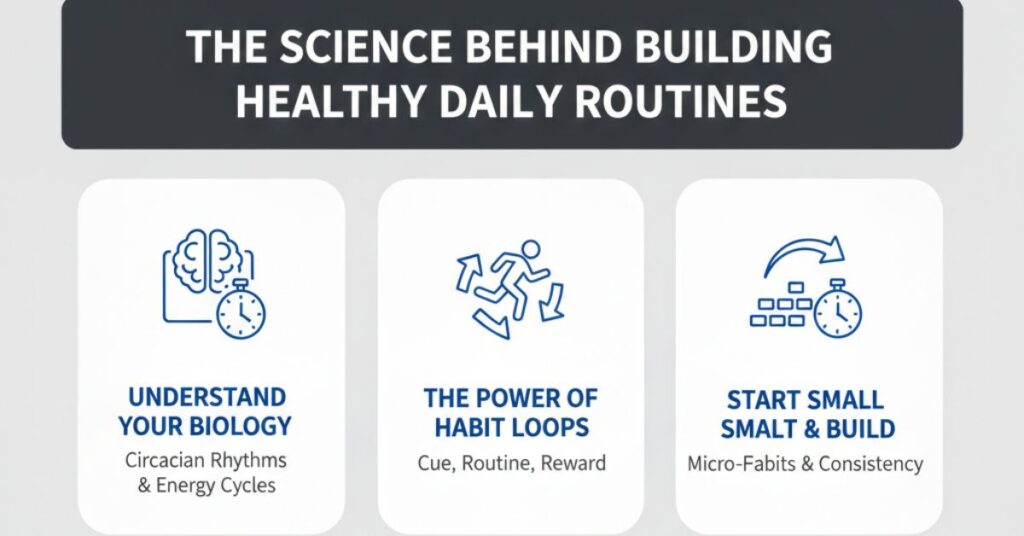
Healthy daily routines are often associated with discipline and willpower, but science shows that lasting routines are built more on psychology, biology, and consistency than motivation alone. The habits people repeat each day shape physical health, mental clarity, emotional stability, and long-term success. Understanding the science behind routines helps individuals create habits that are sustainable, effective, and aligned with how the human brain actually works.
How the Brain Forms Habits
At the core of daily routines is habit formation. Habits are behaviors that become automatic through repetition. Neuroscience explains that habits are formed in the basal ganglia, a part of the brain responsible for pattern recognition and automatic actions.
When a behavior is repeated consistently, the brain reduces the amount of energy needed to perform it. This is why habits eventually feel effortless. Healthy routines become sustainable when they are repeated in the same context and tied to consistent cues.
The Habit Loop: Cue, Routine, Reward
Behavioral science describes habits through the “habit loop,” which consists of a cue, a routine, and a reward. The cue triggers the behavior, the routine is the action itself, and the reward reinforces the habit.
For example, waking up (cue), stretching or exercising (routine), and feeling energized (reward) creates a loop that encourages repetition. Understanding this loop allows individuals to design routines intentionally by choosing cues and rewards that support healthy behavior.
Why Consistency Matters More Than Intensity
Research shows that consistency is more important than intensity when building routines. Small, repeated actions are more effective than drastic changes that are difficult to maintain.
The brain adapts gradually. When habits are too demanding, they trigger resistance and fatigue. Starting with manageable actions—such as a short walk or a brief mindfulness practice—helps the brain accept routines as normal rather than stressful.
The Role of Willpower and Decision Fatigue
Willpower is a limited resource. Studies indicate that decision fatigue reduces self-control over time, making it harder to stick to routines later in the day. This is why successful routines often rely on structure rather than constant decision-making.
Daily routines reduce the number of choices the brain must make. By automating healthy behaviors, individuals conserve mental energy and increase the likelihood of consistency.
Circadian Rhythms and Routine Timing
Biology plays a major role in routine effectiveness. The body operates on circadian rhythms—internal clocks that regulate sleep, energy, and hormone levels. Aligning routines with these rhythms improves results.
For example, morning routines are often effective for physical activity and planning because energy and focus tend to be higher. Evening routines that support relaxation help signal the brain to prepare for sleep. Consistency in timing strengthens these biological patterns.
Dopamine and Motivation
Dopamine, a neurotransmitter associated with motivation and reward, plays a key role in habit formation. Contrary to popular belief, dopamine is released more during anticipation than reward itself.
This means that designing routines with small wins and visible progress increases motivation. Checking off a habit, tracking progress, or celebrating consistency reinforces dopamine release and strengthens routines. Platforms that emphasize intentional systems and progress, such as FIDELETURF , reflect how structure and reinforcement support sustainable growth.
Environment and Behavioral Design
The environment strongly influences daily routines. Behavioral science shows that people are more likely to follow habits when their environment supports them. Removing friction from healthy behaviors and adding friction to unhealthy ones improves success.
For example, placing workout clothes nearby encourages exercise, while keeping distractions out of sight reduces unwanted habits. Designing environments intentionally makes routines easier to follow without relying on motivation.
Stress, Cortisol, and Routine Stability
Chronic stress disrupts routines by increasing cortisol levels, which impair focus, sleep, and emotional regulation. Healthy routines can help reduce stress, but they must be realistic and flexible.
Overly rigid routines increase pressure and guilt when missed. Science supports adaptable routines that allow recovery and adjustment. Flexibility reduces stress while maintaining overall consistency.
Sleep and Routine Formation
Sleep quality has a direct impact on routine adherence. Lack of sleep weakens executive function, impulse control, and emotional balance, making it harder to maintain healthy habits.
Consistent sleep routines improve cognitive performance and emotional resilience. Prioritizing sleep supports every other daily routine, from nutrition to productivity and mental health.
The Role of Identity in Habit Change
Psychological research highlights the importance of identity in behavior change. People are more likely to maintain routines when habits align with how they see themselves.
Instead of focusing solely on outcomes, such as weight loss or productivity, science suggests focusing on identity-based habits. Viewing oneself as “a healthy person” or “someone who values balance” reinforces routine consistency over time.
Tracking, Feedback, and Habit Reinforcement
Feedback strengthens routine formation. Tracking habits increases awareness and accountability. Seeing progress, even in small increments, reinforces commitment and motivation.
However, tracking should support encouragement rather than perfectionism. Missing a habit occasionally does not erase progress. The key is returning to routines quickly without self-judgment.
Long-Term Benefits of Healthy Daily Routines
Over time, healthy routines improve physical health, emotional stability, and cognitive performance. They reduce stress, increase confidence, and support long-term happiness.
Daily routines shape identity and lifestyle. Small habits repeated consistently influence life direction more than occasional bursts of effort.
Conclusion
The science behind building healthy daily routines shows that success depends on consistency, environment, biology, and psychology—not just willpower. By understanding how habits form and aligning routines with brain function and natural rhythms, individuals can create sustainable behaviors that support long-term well-being. Healthy routines are not about perfection but about designing daily systems that make positive choices easier and more natural over time.