
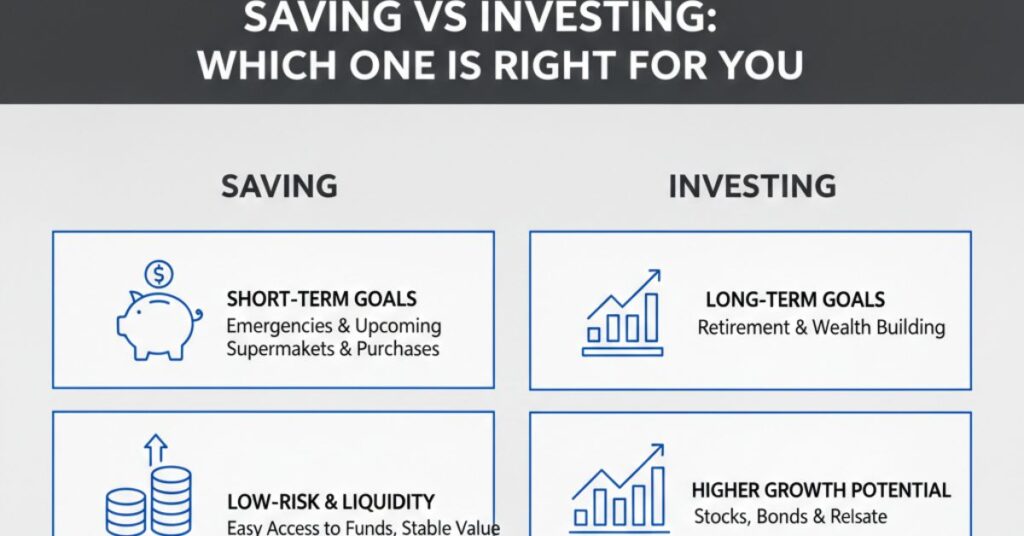
Managing money effectively often comes down to one essential question: should you save or invest? While both saving and investing are critical components of personal finance, they serve different purposes and suit different financial goals. Understanding the differences between saving and investing helps you make informed decisions that align with your needs, risk tolerance, and long-term plans.
Understanding Saving
Saving involves setting aside money in low-risk, easily accessible accounts such as savings accounts, money market accounts, or fixed deposits. The primary goal of saving is to preserve capital and maintain liquidity.
Savings are typically used for short-term needs or emergencies. While savings accounts may earn interest, returns are usually modest and often struggle to keep pace with inflation.
When Saving Makes Sense
Saving is the right choice when:
- You need quick access to funds
- You are building an emergency fund
- You are saving for short-term goals (within 1–3 years)
- You want minimal risk
Savings provide financial security and peace of mind. They act as a safety net that protects against unexpected expenses such as medical bills, car repairs, or temporary income loss.
Understanding Investing
Investing involves putting money into assets such as stocks, bonds, mutual funds, or real estate with the goal of growing wealth over time. Unlike saving, investing carries risk, but it also offers the potential for higher returns.
Investments benefit from compound growth, where earnings generate additional earnings over time. This makes investing particularly powerful for long-term goals.
When Investing Makes Sense
Investing is suitable when:
- You have long-term financial goals
- You can tolerate short-term market fluctuations
- You want to grow wealth faster than inflation
- You have already built an emergency fund
Investing requires patience and discipline. Short-term volatility is normal, but historically, diversified investments tend to grow over long periods.
Platforms that emphasize long-term planning and strategic decision-making, such as FIDELETURF , highlight the importance of aligning financial choices with future-focused goals.
Key Differences Between Saving and Investing
Risk Level
Saving involves minimal risk, while investing carries varying degrees of risk depending on asset type. However, avoiding risk entirely can expose savings to inflation risk, which erodes purchasing power.
Returns
Savings offer lower returns but stability. Investments offer higher potential returns but with market fluctuations.
Time Horizon
Saving is best for short-term goals, while investing is designed for medium- to long-term objectives such as retirement or wealth building.
Liquidity
Savings are highly liquid and accessible. Investments may take time to convert into cash without losses, especially during market downturns.
The Impact of Inflation
Inflation plays a crucial role in the saving vs investing decision. Money kept solely in low-interest savings may lose value over time as prices rise.
Investing helps counter inflation by aiming for returns that exceed the inflation rate. This makes investing essential for preserving long-term purchasing power.
Building a Balanced Financial Strategy
The choice between saving and investing is not an either-or decision. Most financial experts recommend a balanced approach that includes both.
A typical strategy includes:
- Emergency savings for immediate needs
- Short-term savings for upcoming expenses
- Long-term investments for future goals
This combination offers security, flexibility, and growth.
Matching Financial Goals to the Right Approach
Different goals require different strategies:
- Emergency fund → Saving
- Vacation or large purchase → Saving
- Retirement → Investing
- Wealth growth → Investing
Clarity about your goals helps determine where your money should go.
Risk Tolerance and Personal Comfort
Risk tolerance varies from person to person. Some individuals prefer stability, while others are comfortable with market fluctuations.
Understanding your comfort level with risk is essential. Investing should never cause constant anxiety. A diversified portfolio can help manage risk while still pursuing growth.
Common Myths About Saving and Investing
One common myth is that investing is only for wealthy individuals. In reality, many investment options allow small, regular contributions.
Another misconception is that saving alone is enough for long-term security. While saving is important, investing is often necessary to build sufficient wealth over time.
Starting Small and Growing Gradually
You don’t need large sums of money to start saving or investing. Small, consistent contributions build habits and momentum.
Automation helps maintain consistency. Setting up automatic transfers to savings or investment accounts reduces reliance on willpower and encourages long-term discipline.
When to Prioritize Saving First
Before investing, it’s generally wise to:
- Pay off high-interest debt
- Build an emergency fund
- Stabilize monthly expenses
This foundation reduces financial stress and prevents the need to sell investments prematurely during emergencies.
Long-Term Benefits of Investing
Over time, investing supports financial independence and long-term security. Compound growth rewards patience and consistency.
Investing also encourages a future-focused mindset, helping individuals think beyond immediate expenses and plan for long-term success.
The Psychological Aspect of Financial Choices
Saving provides security and control, while investing supports optimism and growth. Both contribute to financial well-being in different ways.
Balancing saving and investing helps reduce anxiety while still pursuing financial progress.
Conclusion
Saving and investing serve different but equally important roles in personal finance. Saving offers security, liquidity, and peace of mind, while investing provides growth and protection against inflation. The right choice depends on your goals, timeline, and risk tolerance. In most cases, the best strategy is not choosing one over the other—but learning how to use both effectively. By balancing saving and investing, you create a financial plan that supports stability today and opportunity for the future.
Read Also: Personal Finance Basics Everyone Should Understand